DFINITY vs. NEAR: The Cryptographic Patent Dispute Over Chain Signatures, Threshold ECDSA, and Confidential Intents Explained
In late October 2026, Dominic Williams, Founder and Chief Scientist of DFINITY, published an exhaustive exposé accusing NEAR Protocol of deploying proprietary and patented threshold cryptography to power NEAR Intents and Chain Signatures. From granted US Patent 12,695,626 to the permissioned architecture of the FAR network and vetKeys overlaps, here is the complete technical and architectural breakdown of the most significant intellectual property conflict in modern Web3.

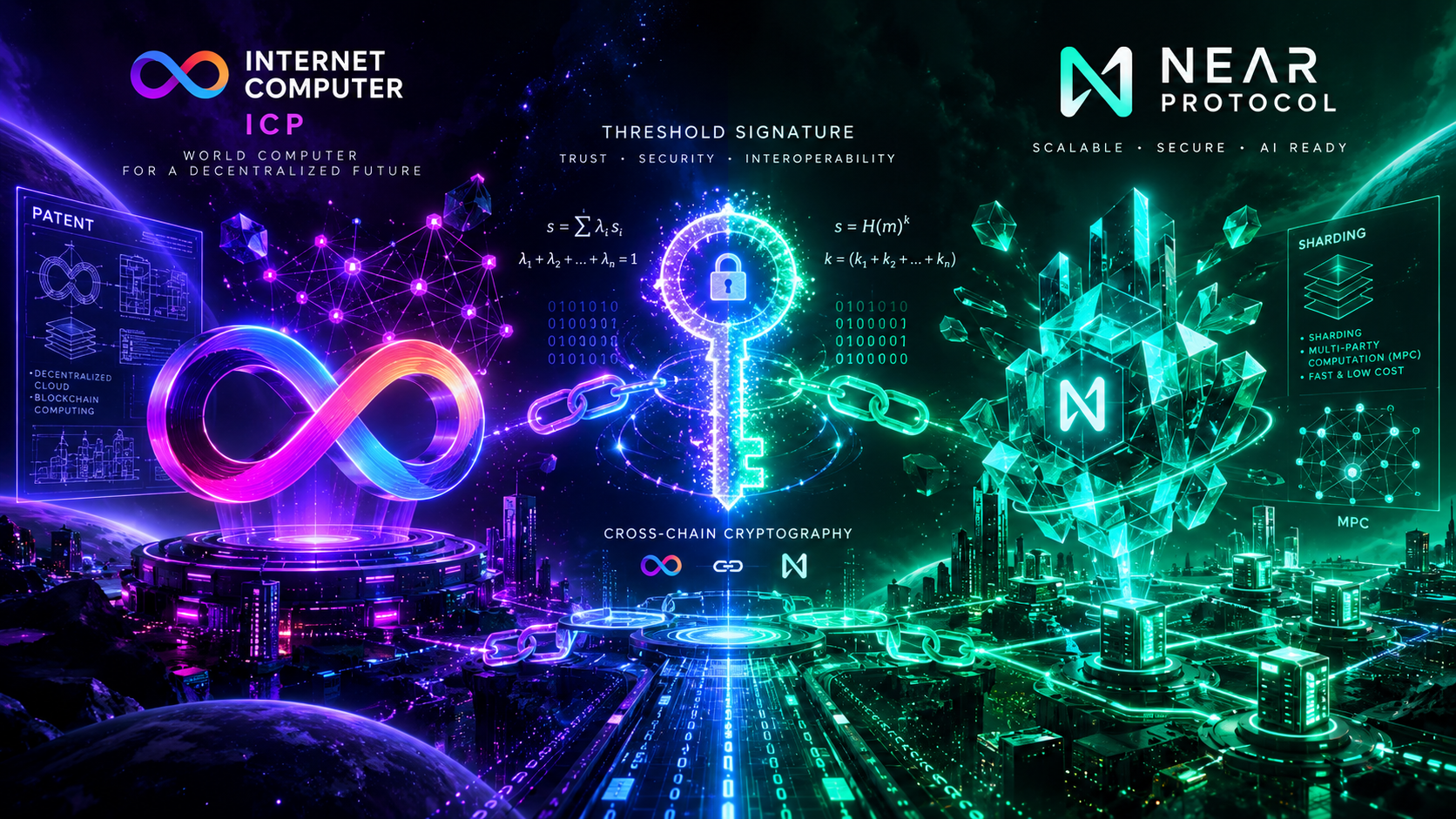
Executive Summary: The Core Points of the Dispute
On October 22–24, 2026, DFINITY Founder Dominic Williams sparked a major industry debate by publicly alleging that NEAR Protocol's celebrated Chain Signatures and NEAR Intents products rely on threshold ECDSA algorithms invented by DFINITY cryptographers Dr. Jens Groth and Dr. Victor Shoup. The claims center on granted US Patent 12,695,626, additive non-interactive child key derivation, alleged code and personnel transfers, similarities between NEAR's Confidential Key Derivation and ICP's vetKeys, and the architectural disclosure that NEAR's Confidential Intents execute on a permissioned private network named FAR rather than decentralized on-chain consensus.
1. The Origins of the Conflict: Dominic Williams' Exposé
The public dispute erupted when Dominic Williams published a long-form article titled “New discovery: NEAR Intents is based on proprietary DFINITY tech” on X, detailing what he described as a systematic appropriation of DFINITY's core cryptographic breakthroughs over a 2.5-year timeline.
For years, threshold digital signature algorithms for elliptic curves—most notably ECDSA (used by Bitcoin, Ethereum, and standard EVM chains) and Ed25519/Schnorr (used by Solana, Cardano, and Polkadot)—represented one of the most notorious open problems in computer science. Standard ECDSA requires a non-linear ephemeral nonce inversion operation during signing (k⁻¹ (z + r · d) mod n), making distributed multi-party computation inherently slow, communication-heavy, and susceptible to abort attacks in asynchronous networks.
To solve this for the Internet Computer, DFINITY assembled a cryptographic research team including Dr. Jens Groth—the world-renowned cryptographer who invented the Groth16 zero-knowledge proof system underpinning zk-SNARKs—and Dr. Victor Shoup, co-inventor of the Cramer-Shoup cryptosystem and pioneer of practical threshold RSA signatures. Together, they engineered a novel protocol for asynchronous threshold ECDSA that unlocked fast, decentralized on-chain signing without exposing master secret keys.
According to Williams, this foundational research was brought to NEAR Protocol following the departure of a former DFINITY employee, leading to the deployment of NEAR's Multichain MPC network and subsequently NEAR Intents. Williams argued that while academic preprints were published for peer review, commercial rights were legally reserved under exclusive patents owned by DFINITY Stiftung to protect the Internet Computer ecosystem.
2. Anatomy of the Patent: US 12,695,626 Explained
At the center of the legal allegations lies United States Patent US 12,695,626, granted on July 28, 2026, and officially titled “Digital signatures with re-randomized presignatures” (available publicly on Justia Patents). The patent lists DFINITY Stiftung as the sole assignee.
The Four Pillars of Patent US 12,695,626
Nodes cooperatively generate raw presignatures in the background during idle consensus cycles before any transaction message is requested. This decouples computationally heavy multi-party multiplication from the user's real-time signing latency.
Before combining shares into a final signature, presignatures undergo non-interactive re-randomization. This mathematically prevents side-channel correlation attacks, timing analysis, and malicious linkage across derived keys.
Allows any canister or smart contract to non-interactively derive virtually infinite child public keys and blockchain addresses (BIP-32 style) from a single master threshold key without requiring node communication or resharding.
When a contract requests an ECDSA signature for a message hash, nodes perform a single, fast linear combination round using an available precomputed presignature, completing the cryptographic signature in a fraction of a second.
Williams asserted that NEAR Protocol's Chain Signatures implementation mirrors these exact claims step for step, relying on the Groth-Shoup re-randomized presignature pipeline to produce ECDSA signatures across external networks like Bitcoin, Ethereum, and Cosmos.
3. Architectural Contrast: ICP Chain-Key Cryptography vs. NEAR Chain Signatures
Beyond intellectual property claims, the debate highlighted fundamental differences between how the Internet Computer and NEAR execute cross-chain threshold signatures in production.
| Architectural Dimension | Internet Computer (Chain-Key tECDSA) | NEAR Protocol (Chain Signatures MPC) |
|---|---|---|
| Consensus Integration | Native protocol-level integration inside Subnet State Machines. No external relayers. | Separate external Multi-Party Computation (MPC) cluster relaying calls to the NEAR contract. |
| Node Hardware & Security | 13 to 34 sovereign hardware nodes running in independent tier-3/4 data centers governed by NNS. | Consortium of multi-party computation signers hosted primarily on commercial cloud servers. |
| Secret Sharing Maintenance | Autonomous Proactive Secret Sharing (PSS): secret key shares are reshuffled periodically without changing the public key. | Static or manual key rotation cycles across active MPC participant nodes. |
| Supported Curves | secp256k1 (tECDSA for Bitcoin, Ethereum) and Ed25519 (tSchnorr for Solana, Cardano, Polkadot). | secp256k1 (tECDSA) with ongoing development for Ed25519 support. |
| Gas & Economic Model | Reverse-gas model paid in Cycles by canister developers. End users pay 0 gas fees for signatures. | Users pay NEAR network transaction gas plus secondary execution fees to external relayer networks. |
| Production Mainnet Track Record | Live on mainnet since 2022; secures over $100M+ in native ckBTC, ckETH, and ckSOL with 0 bridge hacks. | Launched in 2024 as part of NEAR's chain abstraction initiative and expanded into NEAR Intents in 2026. |
4. The FAR Network Controversy: Is “Confidential Intents” Truly Decentralized?
One of the sharpest technical critiques in Dominic Williams' exposé focused not on patents, but on the trust assumptions of NEAR's newly promoted Confidential Intents.
Marketed as an MEV-protected, front-running-immune solution for cross-chain intent swaps, Confidential Intents claims to keep user swap parameters, trade sizes, and slippage thresholds completely private until orders are settled. However, Williams cited technical engineering reviews demonstrating that these confidential orders do not execute on NEAR's public, decentralized blockchain.
Instead, execution is offloaded to a separate permissioned consortium environment known as FAR (Financial Application Runtime).
The Centralization Trap: FAR Architecture Critique
- •Permissioned Private Cluster: The FAR network runs on a small, closed group of permissioned validator nodes operated by designated corporate partners, rather than open, permissionless proof-of-stake validators.
- •Trust-Based Privacy: Confidentiality in FAR is not enforced by trustless zero-knowledge proofs or mathematically verified on-chain threshold encryption. Instead, users must trust that the private node operators will not inspect, collude, or leak their private trade intents before on-chain execution.
- •Regulatory & Subpoena Exposure: Because FAR operators are identifiable entities running in permissioned setups, they face legal vulnerability to regulatory demands, data interception, and court-ordered disclosure, compromising the censorship-resistance promised by Web3.
In contrast, on the Internet Computer, all Chain-Key operations occur within public subnets managed by the decentralized Network Nervous System (NNS). Every byte of canister execution and state transition is verified by consensus across independent global data centers, eliminating reliance on private side-channel consortiums.
5. vetKeys vs. Confidential Key Derivation (CKD)
The controversy deepened further when Dominic Williams drew parallels between NEAR's newly unveiledConfidential Key Derivation (CKD) proposal and DFINITY's pioneering vetKeys (Verifiable Encrypted Threshold Keys) framework.
On public blockchains, data is by definition visible to every validating node. Storing sensitive user data—such as medical records, private financial messages, or autonomous AI agent keys—requires a mechanism where the smart contract can encrypt data for a specific identity without the nodes ever learning the underlying decryption key.
DFINITY developed vetKeys to solve this using threshold identity-based encryption (IBE). In vetKeys, the subnet holds shares of a master secret key. When a user requests their decryption key, nodes generate encrypted decryption key shares that only the authenticated user can combine using their private transport key. At no point can any node operator, canister developer, or eavesdropper inspect the plaintext key.
Williams pointed out that NEAR's marketing of Confidential Key Derivation mirrors the architectural principles and mathematical mechanics that DFINITY open-sourced through academic whitepapers and developer presentations over the past two years, arguing that another pillar of ICP's privacy roadmap was being rebranded without attribution or licensing.
6. The Industry Debate: Open Source Research vs. Patent Protection
The clash has ignited fierce discussion across the broader Web3 ecosystem, pitting traditional open-source crypto ethos against corporate intellectual property rights.
The NEAR & Open-Source Defense
- •Academic Research is Public Domain: Proponents argue that cryptographic papers published on ePrint and arXiv are meant for the advancement of the entire blockchain industry.
- •Independent Re-implementation: NEAR community members assert that writing clean-room code based on public cryptographic formulas does not constitute illegal theft.
- •Skepticism of Crypto Patents: Many Web3 developers express philosophical opposition to software patents in general, warning that patent wars will stifle decentralization and cross-chain innovation.
The DFINITY & Institutional Position
- •Academic Publication ≠ Commercial License: Publishing a scientific paper for peer review does not grant commercial competitors permission to infringe on registered patents.
- •Massive R&D Investment: DFINITY spent tens of millions of dollars employing world-class cryptographers to solve unsolvable problems; allowing funded competitors to take it without licensing undermines foundational research.
- •Downstream Legal Risk: Third-party dApps, exchanges, and institutions utilizing infringing technology could potentially face legal liability or patent injunctions.
7. What Builders & Enterprises Need to Know
For developers building cross-chain DeFi applications, autonomous AI agents, and non-custodial wallets, the dispute offers essential architectural and legal takeaways:
- Verifiable Security Trumps Marketing: Trust-minimized threshold signatures require genuine decentralization across independent hardware nodes. Offloading critical signing or intent routing to private consortium networks re-introduces the centralized honeypots that blockchain was created to replace.
- Intellectual Property Diligence: As crypto infrastructure matures, patents granted in key jurisdictions like the US, Switzerland, and the EU carry real commercial weight. Projects must audit the licensing provenance of the cryptographic libraries they embed into their smart contracts.
- ICP Remains the Gold Standard for Chain-Key Interoperability: With over four years of battle-tested mainnet operation, native support for Bitcoin, Ethereum, and Solana, and patent-cleared threshold cryptography, Internet Computer provides the most robust, decentralized foundation for multichain chain abstraction.
Frequently Asked Questions
What are Dominic Williams' core allegations against NEAR Protocol?
Dominic Williams, Founder and Chief Scientist of DFINITY, publicly alleged that NEAR Protocol built its flagship Chain Signatures and NEAR Intents technologies using proprietary, patented threshold cryptography invented by DFINITY cryptographers Dr. Jens Groth and Dr. Victor Shoup. He cited granted US Patent 12,695,626 covering threshold ECDSA with re-randomized presignatures, alleged that NEAR copied non-public implementations brought over by a former DFINITY employee, and criticized NEAR's Confidential Intents for relying on a permissioned private network called FAR rather than decentralized cryptography.
What is US Patent 12,695,626 and why is it significant?
US Patent 12,695,626, titled 'Digital signatures with re-randomized presignatures', was granted on July 28, 2026, and assigned to DFINITY Stiftung. The patent covers an asynchronous threshold ECDSA protocol that precomputes cryptographic presignatures, re-randomizes them to eliminate linkage and side-channel leakage, and enables rapid on-demand signature synthesis under additive non-interactive child key derivation. This protocol serves as the mathematical foundation for Internet Computer's Chain-Key technology, enabling canisters to sign Bitcoin, Ethereum, and other transactions natively.
How does NEAR's Chain Signatures compare to ICP's Chain-Key Cryptography?
While both systems aim to achieve cross-chain interoperability and chain abstraction without custodial bridges, their architectures diverge fundamentally. ICP's Chain-Key cryptography is integrated directly into the core consensus layer of public decentralized subnets (13 to 34 sovereign hardware nodes), executing via deterministic on-chain canister calls with proactive secret sharing and reverse-gas billing. NEAR Chain Signatures operates as an external multi-party computation (MPC) network running separate nodes that relay signatures back to the NEAR blockchain.
What is the controversy surrounding NEAR's Confidential Intents and the FAR network?
NEAR promoted Confidential Intents as an MEV-shielded privacy solution for cross-chain execution. However, architectural reviews highlighted by Dominic Williams revealed that these confidential intents execute on an external permissioned consortium chain called FAR (Financial Application Runtime). Because FAR is operated by a small, closed set of permissioned nodes rather than a decentralized public consensus, critics argue that the privacy guarantees depend on trusting private operators rather than verifiable on-chain zero-knowledge or threshold encryption.
How does NEAR's Confidential Key Derivation relate to ICP's vetKeys?
Dominic Williams pointed out strong conceptual and mathematical overlaps between NEAR's newly promoted Confidential Key Derivation (CKD) and DFINITY's vetKeys (Verifiable Encrypted Threshold Keys) framework. vetKeys allows on-chain canisters to provide verifiable threshold identity-based encryption and private key shares without exposing plaintext secret keys to node operators, representing a critical primitive for confidential on-chain computation.
What does this patent dispute mean for developers building cross-chain applications?
For developers and institutions evaluating chain abstraction stacks, the dispute underscores the importance of IP diligence and underlying security assumptions. Protocols relying on NEAR Chain Signatures may face legal uncertainties if formal patent enforcement actions are initiated, while also depending on external MPC relayers. In contrast, ICP's Chain-Key infrastructure offers native, patent-cleared, battle-tested threshold signing that has secured billions of dollars in Bitcoin (ckBTC) and Ethereum (ckETH) on mainnet without bridges.
Experience True Sovereign Chain-Key Cryptography on ICPay
ICPay leverages the Internet Computer's native, patent-cleared Chain-Key cryptography to deliver instant, gasless crypto payments, decentralized token launches, and on-chain cloud storage without custodial bridges or private relayer networks.
